Posts

Showing posts with the label Bird spotting

Oriental Honey Buzzard

Image
Oriental Honey Buzzard Gujarati Name : મધીયો બાજ Hindi Name : Madhuya Ahmedabad gets really hot in summers ( around 45-48 deg Celcius). Even though we stay indoors, it becomes unbearable without air conditioners. Even animals around our house, dogs, cats and birds reduce all their activities post 11 am only to resume at around 4 or 4.30 pm. So, it is unusually quiet in the garden in afternoons in this season. Last week, while busy with my meeting online one evening, sitting near a window, I saw a shadow of a large bird flying by. Suddenly, all the birds dispersed frantically for shelter. It was definitely a predatory bird which had come for surveillance. I wanted to leave the desk and investigate but that would seem so unprofessional. Oriental Honey Buzzard So, once I was disengaged, I leapt for my camera to take a chance and see if the bird was still around. Fortunately, things had not returned to normal out there. Changing into dull earthy colored clot...

Grey Francolin

Image
Gujarati Name : તેતર , ધુળીયો તેતર Hindi Name : सफ़ेद तीतर Most of the common birds of India such as parrots, sparrows, peacocks, crows etc play a significant role in our folklores in the form of tales, poems, proverbs or riddles. One of the most popular riddle has Grey Francolin as the lead. तीतर के दो आगे तीतर तीतर के दो पीछे तीतर आगे तीतर पीछे तीतर बोलो कितने तीतर The first time I heard this, I admit, I paid little attention to ‘Teetar’ and was least interested in how it looked. Even though most of my childhood summers I have spent in villages (Baramati) in Maharashtra or (Kapadwanj) in Gujarat, I had never seen nor heard this bird. The first time I heard it was in 2016, when we moved to ‘Mitthi’. For many months I could only hear their call ….’ka…tee..tar…ka…tee…tar’ or ‘ pa…tee..la…pa…tee..la’ while they remained camouflaged. These birds come to feed on the grains we scatter for them at the far end of our garden. One quiet afternoon, a casual glance towards the feeder...

Red Naped Ibis

Image
  Hindi name : करांकुल, काला बाझ Gujarati name : કાળી કાંકણસાર                                                                                                                 A rare visitor in a non-monsoon season, this one dropped by last week. Of the 3 species of Ibis found in India, this one prefers an open country side , a little away from the water body, and that explains the stopover at Mitthi. It is also often seen feeding with egrets and other birds on agricultural land being tilled. A crimson red squarish caruncle on its featherless head is what gives it its distinctive name. A large blackish brown bird with blue-green gloss, is difficult to go unnoticed but since they are silent...

Charming whistlers: Common Iora

Image
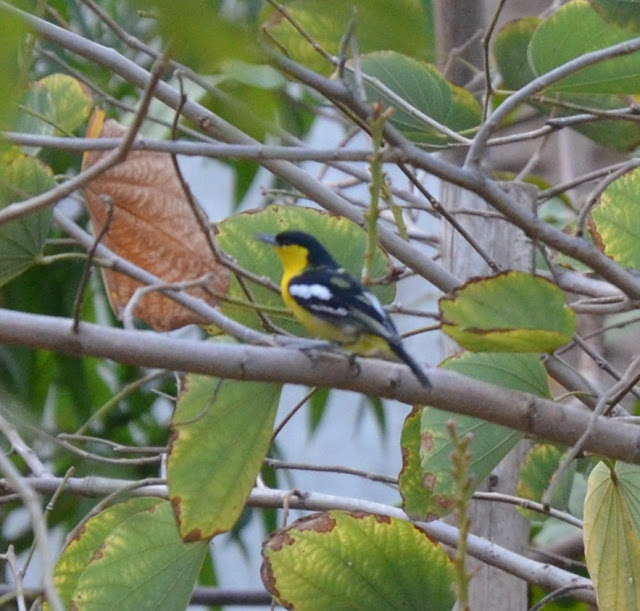
Common Iora Male Common Iora Male Gujarati Name: શૌબિન્ગા, શોબિગી Hindi Name: शाऊबीगी What would you do when you are chatting with a close relative, discussing ‘Lockdown’, and you spot an unfamiliar bird few feet away across the French window, in the garden? Cutting short would have been rude and the conversation was nowhere close to an end. So, keeping the person engaged in our talks through monosyllables and on speaker, I tried to get a better glimpse of the bird, all the while remaining indoors. Over my last few months of studying behaviors of various birds, I have noticed something which was very unusual or rather unknown to me. Birds also like to follow a 'Schedule' and 'Pattern'. Post my first sighting of Iora on my purple Kachnar tree at around 4pm, I kept a check on their visit in the same place at around same time. And I was pleasantly surprised to see them visit it again, almost daily. Due to the temperature going up, their timings ...

Friendly Oriental Magpie Robins

Image
I started the birds in my backyard series with our national bird, Peacock. And coincidentally this one happens to be the national bird of our neighboring country- Bangladesh. A bird majorly black in color with dark blue hue on its head, has white underbelly and a streak of it on the wings and the tail. Perches on trees and branches not too high or hops along the ground foraging for food under the dried leaves. An extremely noticeable bird not only due to its color which is stark contrast to its surroundings, but more so for its sweet and melodious call made during early mornings or evenings. I have mostly spotted oriental magpies in farms, gardens and bushes near villages so I assume they like to stay close to humans. By now I can identify 3 to 4 different calls of this bird but yet to know what it means ( work in progress). It is very amusing to see its tail flick up and down in sync with its sallies. Quiet similar to the tail of the squirrel which moves involuntaril...